• The UK government and police have taken newly repressive measures to discourage anti-genocide and anti-Zionist protests through criminalisation of the slogan ‘Globalise the Intifada’. Keir Starmer tells us that “if you stand alongside people who say ‘globalise the intifada’, you are calling for terrorism against Jews, and people who use that phrase should be prosecuted.” At least seven people have now been arrested for allegedly using the slogan in the UK alone, and the slogan is also outlawed in Germany and parts of Australia.

    Starmer’s defamatory claims have already been refuted by members of BRISMES and by expert specialists working at the University of Leeds, complemented by a collective letter signed by hundreds of scholars and published online.

    This event discusses what the term intifada actually means through the history of uprisings and anti-colonial resistance across the Arabic speaking world. Drawing on examples from the Palestinian intifadas of 1936, 1987 and 2000, the Iraqi Intifada of 1952, the Bahraini uprising of 1956 and numerous other struggles it will explain the significance for Palestinian liberation in particular, and why it remains such an important strategic slogan to this day.

    Speakers:

    Our government has criminalised some public uses of the word ‘intifada’ precisely because it has deep resonance with struggles for liberation across the world. Come and find out more about the real history that this repression aims to erase and how we can turn lessons from the past into activist strategy today.

    Hosted by: Protest is not Terrorism and BRISMES, co-sponsored by BRICUP

    Sign up to this event here: https://actionnetwork.org/events/intifadahistory

  • On Friday 12 June 2026, at Woolwich Crown Court, four remarkably courageous and principled members of Palestine Action were each condemned to five or more years of prison. They were punished for destroying around 40 lethal drones made by the genocide-enabling Israeli arms company Elbit Systems, a company that continues to operate in the UK with the full protection of the British legal system. The punishment meted out to these first four of the 25 Filton defendants sets a very grim and ominous precedent for the future of British civil liberties and our right to protest, including what remains of our highly restricted rights to protest heinous state crimes like genocide.

    As the Filton case judge Jeremy Johnson explained in his almost cartoonishly punitive sentencing remarks late on Friday afternoon, technical justification for the exceptional sentences was provided by his attribution of a “terrorist connection” to the Filton operation. 

    This sent shockwaves of alarm all through the judicial system and related sectors. In the weeks leading up to 12 June, scores of outraged lawyers and law professors, along with many hundreds of educators, healthworkers, and artists, signed collective letters condemning such a brazen manipulation of anti-terrorism laws in particular and this government’s wider repression of political protest more generally. 

    On 12 June itself, directly outside the fenced-off premises of Woolwich court, the Filton 25 campaign maintained a non-stop rally with one remarkable speaker after another from 10am to till 7:30pm. A few yards away, around 250 people strung out in a long line along the road participated in an act of mass civil disobedience organised by Defend Our Juries, holding placards that read: “Saving lives is not terrorism, I support Palestine Action.” (Only around a third of the sign-holders were arrested before the police, for reasons they didn’t explain, simply gave up on enforcing their so-called “anti-terrorism” law in mid-afternoon – leaving scores of apparent “terrorists” entirely at liberty on a busy London street).

    Undeterred, late on the Friday afternoon, Johnson followed through on his plans to make a clear example of the Filton actionists, and gave all four of them sentences of extraordinary severity. He condemned Charlotte Head and Leona Kamio to a six-year “special custodial sentence,” which includes a minimum of five years’ jail time; he condemned Fatema Zainab Rajwani to the same sentence minus four months; he condemned Samuel Corner (who in addition was convicted of grievous bodily harm without intent) to a total sentence of almost nine years in custody. 

    Judge Johnson’s obscene judgement reads as a full-throated defence of genocide as a protected business model. Livestreamed by Sky News, his sentencing remarks were relayed in real time to the mass of stunned Pal Action supporters outside the court. He confirmed that it makes no legal difference whatsoever, as far as the British state is concerned, whether Elbit is making weapons of mass assassination or (to evoke an alternative mentioned during the trial by the Filton defence counsel) fluffy toys for children. “Throughout the case,” Johnson told the defendants, “you have sought to portray Elbit as a criminal company,” one engaged in crimes against humanity in Palestine, apparently forgetting that Johnson’s court has no interest in any sort of “political or legal argument about the role or conduct of Elbit in those events.” Since “Elbit is not on trial,” he continued, so then it would be “quite wrong for the court to make findings about its conduct in order to inform an evaluation of the seriousness of your offending.” All that matters, Johnson went on, is the exceptional seriousness of your own offense, compounded by its “exceptionally high degree of both planning and premeditation […]. The harm that you caused and intended to cause and the harm that your offending might foreseeably have caused were all exceptionally high,” thereby justifying the “significant upwards adjustment” to your sentences.

    People who have more direct experience than Mr Justice Johnson of how Elbit’s products are actually used in Gaza might be forgiven for seeing things a little differently. The speakers who contributed to a brief press conference that took place outside the court immediately after Johnson’s pronouncement all tried to address the point that Johnson refuses to see. The Filton co-defendant Zoe Rogers (who was acquitted of criminal damage last month) quietly observed that the Elbit “weapons we destroyed will never be able to kill people. They will never be able to take away people’s parents, their friends, their children.”

    Sukaina Rajwani (mother of the defendant Fatema Zainab Rajwani), noted that the British state has responded to Palestine Action as an intolerable threat to business as usual. “When the state holds 21-year-olds without trial for 19 months, stitches up a retrial, then locks them away as terrorists, you realise how scared they are – scared of Fatema Zainab, scared of Ellie, scared of Lottie, scared of Sam, scared of us, scared of our movement, scared of the community we have created, scared of their actions and resilience inspiring thousands more.”

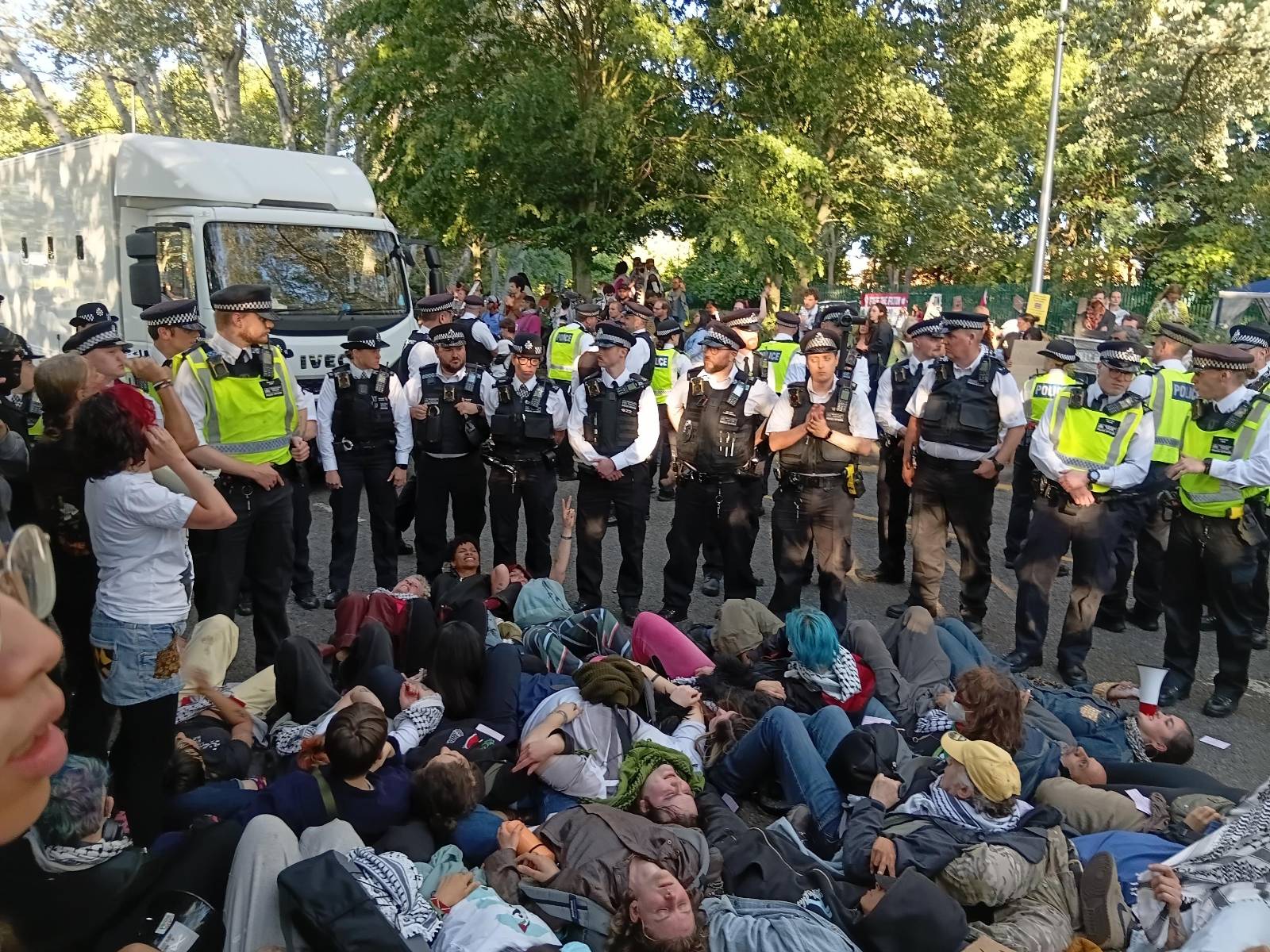
    Just as the Filton campaign’s press conference came to an end, the Serco van carting the four defendants off to their next stint in prison made an ill-timed attempt to drive out onto the main road, and was promptly blocked for more than an hour. For a long time it seemed like it would be stuck there indefinitely, as scores of campaigners refused to be cowed by the increasingly frustrated and violent police. Eventually enough of the people lying in the road were roughly dragged away and arrested, allowing the van to reverse and speed off in the opposite direction.

    It’s incredible to think that the state’s vicious persecution of the Filton 25 and Brize Norton 6 is still only just beginning, as the next Filton trial started on Monday 15 June. Presumably the Crown Prosecution Service intends to take an even more draconian line against the BN6, who have already been subjected to exceptional forms of pre-trial punishment in prisons scattered across the country. 

    The trials continue, as the saying goes, and they are bound to continue for as long as British judges like Jeremy Johnson, along with British politicians like Keir Starmer and Shabana Mahmood, consider it more just and more important to enable rather than prevent the perpetration of genocide.

  • To: Justice Jeremy Johnson

    On 12 June 2026, a British court will seek to attach a “terrorism connection” to the sentencing of four Palestine Action activists, even though they were not charged, tried or convicted under terrorism laws. Three out of the four have only been convicted of criminal damage, and the 18 months they have already spent in custody before trial would in normal circumstances mean they would be unlikely to face any more time in jail.

    The “criminal damage” they committed was to dismantle some of the military equipment in a factory owned by Israeli arms manufacturer Elbit, including sniper quadcopter drones whose documented use has contributed to Israel’s ongoing genocide in Palestine. Yet the judge prevented the defence from referring to this fact and concealed plans to impose harsher sentences through reporting restrictions banning the media from even talking about this aspect of the case.

    We join colleagues who work in healthcare and law in condemning this gross abuse of judicial power. We demand that the terrorism connection is dropped when the Filton activists are sentenced. We call on the Labour government to end its repressive policies towards direct action and civil disobedience movements which play an essential democratic role in by demanding accountability for war crimes, genocide and climate breakdown. We urge the repeal of Britain’s vaguely worded terrorism laws which have opened the door to this authoritarian move.

    Our unions and professional associations must take clear and forceful steps to oppose the use of terrorism powers against conscientious protest, and defend the right of all teachers and education workers to speak and act against genocide and other crimes against humanity.

    Signed (in a personal capacity)

    Trade union officers

    Sunil Banga, Lancaster University, UCU Branch President
    Peter Bicknell, Lewisham College, UCU Branch Chair
    Mandy Brown, UCU London Region Chair
    Donna Brown, Royal Holloway University London, UCU National Executive Committee (NEC)
    Peta Bulmer, Liverpoool University, UCU NEC
    Grant Buttars, University of Edinburgh, UCU NEC
    Anastasia Christou, Middlesex University, UCU Chair Equalities
    Deepa Driver, Reading University, UCU NEC
    Peter Evans, West London College, UCU NEC
    Alex Gordon, RMT former President
    Norman Hagan, University of Ulster, UCU Branch Chair
    Elane Heffernan, Kent University, UCU Equality Officer
    Marion Hersh, Glasgow University, UCU NEC
    Jill Kennedy-McNeil, Morley College, UCU NEC
    Taylor Hill, Dundee University, UCU Women’s Officer
    Alyson James, Branch Chair, Westminster Kingsway College, UCU
    Dyfrig Jones, Bangor University, UCU President
    Lesley Kane, Open University, UCU NEC
    Rhiannon Lockley, Branch Chair Birmingham City University, UCU NEC
    Joel Maddock-James, York St John University, UCU Branch Secretary
    Tania Manyuira, Sandwell College, UCU Branch Vice Chair
    Marian Mayer, Bournemouth University, UCU NEC
    Rich McEwan, Vice Chair FEC, Branch Chair NCC Poplar, UCU NEC
    Christina Paine, London Metropolitan University, UCU NEC
    Matt Perry, Newcastle University, UCU Branch Chair and NEC
    Regi Pilling, Westminster Kingsway College, UCU Branch Secretary and NEC
    Mark Taylor-Batty, Univerity of Leeds, UCU NEC
    Marco Tesei, West London College, UCU NEC
    Suzi Toole, Bolton College, UCU Vice President
    Sean Vernell, City and Islington College, UCU NEC
    Sean Wallis, University College London, UCU Branch Secretary, UCU London Regional Secretary, UCU NEC
    Kevin Ward, Middlesex University, ARPS Committee, UCU NEC
    Cecilia Wee, Royal College of Arts, UCU NEC
    Saira Weiner, Liverpool John Moores University, UCU NEC
    Richard Wild, Greenwich University, UCU NEC

    Individual signatories (including trade union members and local reps, campaign officers and individuals)


    Liz A Gray
    Jeanette Abendstern
    Eadaoin Agnew, UCU
    Fauzia Ahmad
    Anne Alexander, Rep, Cambridge UCU
    Euphrosyne Andrews
    Renate Aspden
    Phil Baber, AOb
    Gill Barn, Unison
    Kate Bennett, Union rep, University of Liverpool, UCU
    Huw Beynon, UCU
    Justin Blakebrough
    Sheila Bouitieh
    Harriet Bradley, UCU
    Sara Bragg, UCU
    Ray Brassier
    Diana Brighouse
    Briony Brooks, Union rep, UCU
    Ray Campbell, Union rep, UCU
    Amanda Carter
    Mihail Chiru, UCU
    Dharminder Chuhan, Union Rep, Sandwell College, UCU
    Laura Clarke, Unison
    Garry Clarkson, National Union of Journalists
    Owen Clayton, UCU
    Jill Coleman
    Zoë Collins
    Vicky Crewe, Union Rep, Sheffield University, UCU
    William Crosby, UCU
    Timothy Crowther, NEU
    James Dickins, Union Rep, UCU
    Wojciech Dmochowski, UCU
    Eddie Dougall, BECTU
    Allison Drew, UCU
    Karl Drinkwater
    Gair Dunlop, UCU
    Dan Elphick, Union rep, UCU
    Rick Evans, Unite
    Karen Evans, UCU
    Kate Ferguson, UCU
    Lorna Finlayson, UCU
    Sophie Franklin
    John Garrett
    Joanne Gatenby
    Raymond Geuss
    Martin Giddey, Equality Officer, UCU
    Jo Gilks, Unison
    Aisling Gilligan
    Thanasis Giouras
    Sylvia Godfrey
    Priyamvada Gopal, UCU
    Louise Gray, Unison
    Penny Green, Queen Mary University London, UCU
    Tess Green, UNISON
    Winmarie Greenland, NEU Retired
    Tony Greenstein, Unite
    Chris Griffin
    Rupert Gude
    Peter Hallward, Kingston University, UCU
    Lisa Halse
    Ian Halverson
    Sue-Ann Harding, UCU
    Nicola Harrison, NEU
    Jane Hawkes
    Matt Haycocks, UCU
    Brenda Herbert, UCU
    Alison Hersey
    Margot Hill, Union rep, Retired Members, UCU
    Helen Hills, UCU
    Peter Hirst
    Aggie Hirst, UCU
    Nick Hodgkinson
    Gary Howkins
    Rosemary Kate Hughes, Unison
    Catherine Hughes, Unite Community
    Feyzi Ismail, UCU
    Geetika Jain, Union Rep, UCU
    Diana Jeater, Branch committee, Liverpool John Moores University, UCU
    Joanne Jones
    Anthea Jones, NEU
    Lewis Jones, Union Rep, UCU
    Lyes Kahouadji, Union rep, UCU
    David Kaplan, Union Rep, Working Mens College, UCU
    June Kathchild, Union Rep, Retired Members, UCU
    Surinder Kaur, UNISON
    Rose Kaye
    Frances Kelly, PCS
    Cormac Kelly, NEU
    Michelle Staggs Kelsall, UCU
    Tassia Kobylinska, UCU
    Janet Koike
    Anja Komatar, Union Rep, UCU
    Natalie Kopytko, School Rep, UCU
    Richard Kuper, UCU
    Fiona Leach, UCU
    Mark Levene
    Brian Lobel, UCU
    Yosefa Loshitzky
    Michael Loughlin
    Thembi Luckett, UCU
    Lauren MacGowan
    Deborah Mallender
    Margaret Manning, UNITE
    Vicky Marsh
    Caroline Martin, UCU
    John McCartney, Unison (Retired)
    Esther McIntosh, UCU
    Steve McKenzie, Unite
    Will McMahon, UCU
    Roseanne McNamee, UCU
    Robyn Mcsharry, NASUWT
    Alex Merron, Green Rep, UCU
    Angie Mindel, NEU
    Harry Mitchell
    David Mond, UCU
    Linda Moore, Union rep, UCU
    Carlo Morelli, Union Rep, UCU
    Susan CR Morgan
    Nushi Nazemi, N/A
    Liam O, UCU
    Simon O’Hara, Warwickshire NEU
    Mark O’Leary
    Robyn Orfitelli, Union Rep, Sheffield University, UCU
    Adam Ozanne, UCU Trustee, UCU
    Anna Pollert, UCU
    Megan James Povey, Union rep, UCU
    Nicola Pratt, UCU
    Cherie Pruden, Unison
    Paola Quevedo, Unison
    Martin Ralph, Union Rep, Liverpool University, UCU
    Anandi Ramamurthy, UCU
    Joe Redmayne, Health and Safety Rep, Newcastle University, UCU
    Claudia Regan, Union Rep, City of Bristol College, UCU
    Lara Rettondini, UCU
    Deirdre Aine Reynolds
    Louanne Richards
    Nils Rickardsson Olsson, UCU
    Matt Riemland, UCU
    Susanna Riviere
    John Rogers, Unison
    Rachel Rosen, UCU
    Leon Rosselson, Musicians’ Union
    Stephen Rowell, NEU
    Caroline Royds
    Gabrielle Russell, UCU
    Ruth San Martin, OPSEU
    Rosie Sauvage
    Josie Scott, Union rep, UCU
    Tanya Serisier, UCU
    Rachel Shanks, Union Rep, UCU
    Martin Shaw
    Ellen Shobrook, Branch Committee, University of Birmingham, UCU
    Andy Shuttleworth, Union Rep, UCU
    Shiva Sikdar, UCU
    Stephen Slator
    Roddy Slorach, Union Rep, UCU
    Alasdair Smith, NEU
    Jess Snell
    David Somervell, UCU
    Nick Soper, Unite
    Lorea Soto, Union Rep, City of Bristol College, UCU
    Roger Southall
    Peter Spillane, Unite
    Sue Spilling
    Urmilla Stoughton
    Mark Stuart-Smith, UCU
    Mayssoun Sukarieh, UCU
    William (Steve) Sydenham, Retired
    Graham Towl
    Fay Turner
    Ronnie Turus, UCU
    Alyson Tyler
    Diana Vallverdu, Union rep, Norwich University of the Arts, UCU
    Tim Varlow
    Loes Veldpaus, Branch Sec, Newcastle University, UCU
    Daniel Vulliamy, UNITE
    Stephen Wagg, UCU
    Colin Walker
    Pat Walmsley, NEU
    Owen Walsh, UCU
    Ian Walters, NEU
    Janet Watson, UCU
    Stephanie Webber, Artists Union England
    Lynn Welchman, UCU
    Rosemary White
    David Wilson, UCU
    Andy Wood, UCU
    Lesley Wood
    Brian Woodward
    Pam Wortley, Unite
    Fiona Wright
    Rita Wright, Union rep, Retired Members, UCU
    Mary Wyatt
    Janine Young

    Background

    Back in August 2024, Sam Corner, Ellie Kamio, Lottie Head and Fatema Zainab Rajwani were among a group of six activists who broke into a factory operated by Israel’s largest arms manufacturer, Elbit Systems, located in the Filton neighbourhood of Bristol. Once inside, the activists damaged or dismantled some of the military equipment they found, include sniper quadcopter drones whose documented use has contributed to Israel’s ongoing genocide in Palestine.

    The activists were arrested on the scene and kept in prison on remand for more than eighteen months. Once their case eventually went to trial in November 2025 they readily acknowledged that the purpose of their raid on the Filton factory was to put some of Elbit’s munitions out of use. Although their judge Mr Justice Jeremy Johnson set exceptionally severe limits on what they and their barristers were allowed to tell the jury, they tried to explain that they had intended to damage these weapons in order to save the lives of at least a few people exposed to Israel’s relentless attacks on Gaza. Presumably because they were convinced by these explanations, in February 2026 the jury refused to convict any of the Filton defendants on any charge; they acquitted them of the more serious charges like aggravated burglary, and left the lesser charge of criminal damage undecided.

    Government prosecutors quickly decided to retry the Filton activists on this lesser charge, and judge Johnson now imposed even stricter limits on their lawyers could tell the new jury (or share with the wider public). This new jury was then asked to rule on whether or not the six Filton activists had committed acts of criminal damage. In the light of the judge’s instructions, on 5 May the jury found four of the six guilty as charged. What the jurors didn’t know, however — and what until recently the wider public also hasn’t known — is that from the beginning of the trial the judge was planning to sentence those convicted not for the relatively mild offence of criminal damage but for the much more serious and life-changing crime of terrorism.

    If the prosecution application is successful, the Filton 4 will see their jail sentences extended, early release provisions disapplied, and upon eventual release they could be licensed as terrorists for up to 15 years, requiring them to register any new device, bank account, email, or relationship with the police.

    This is a test case, and if the Filton judge gets away with this, the precedent could help to suppress all forms of conscientious protest. (In addition to criminalising perfectly legitimate slogans like “globalise the intifada,” one minor indication of the government’s current priorities is suggested by the fact that, immediately after he secured these Filton convictions in early May, judge Johnson was promoted to the role of Deputy Senior Presiding Judge of England and Wales).

    As the campaigning civil liberties group Defend Our Juries has explained, if Keir Starmer’s judiciary is allowed to slap a vaguely worded “terrorist connection” on to a non-terrorist offence then such chilling tactics “could be used against any activist accused of criminal damage relating to any cause, regardless of whether they are connected to a group or organisation. This would be the first time in British history that this has ever happened. We must oppose this with all our might.”

    This open letter will be handed into the court before the sentencing on June 12th. 


    See also the open letter from members of the legal profession here 

  • The Filton 4 will be sentenced at Woolwich Crown Court on Friday 12 June. The judge, Mr Justice Jeremy Johnson, is almost certain to attach a draconian “terrorism connection” to their sentences, even though they were not charged, tried or convicted under terrorism laws. A last-minute motion to remove judge Johnson from the case will be heard on Monday 8 June.

    The four Filton defendants are highly principled non-violent peace activists. They are people who refused to remain bystanders to crimes against humanity, and who resolved instead to act directly on our shared obligation to prevent genocide. To condemn and imprison them now as “terrorists” is both a grossly authoritarian abuse of power and an exercise in pure defamation. Nothing like this has ever happened before in the UK and so this case may set a very ominous and far-reaching precedent. If an ordinary act of criminal damage to property can be reframed as “terrorism” because it was motivated by clear moral and political principles, then all kinds of conscientious protest are now vulnerable to state repression.

    Israel’s genocide and annexations continue to escalate, and more than twenty other Filton and Brize Norton defendants are still awaiting trial.

    The Free the Filton 25 campaign group is therefore urging everyone who is within reach to the Woolwich court to protest this miscarriage of justice, to demand the immediate release of the Filton 4, and the lifting of the ban on Palestine Action (a ban the high court already ruled to be “unlawful,” back on 13 February). People will be gathering outside the court from around 10am. More information is posted at https://filtonactionists.com/.

    As part of this protest at the Woolwich court on Friday 12 June, Defend Our Juries is organising another defiant sign-holding action. Participants will hold signs that read ‘Saving lives is not terrorism, I support Palestine Action.’ There’s more information, along with times of open calls and a very useful and thorough action briefing document at https://defendourjuries.net/open-calls/. Sign-holders will be gathering at 12:30, with the action scheduled to start at 1pm.

    If for any reason you are unable to risk arrest by holding such a sign, but would still like to support the action, PNT is helping to organise a witness circle, to gather as many people as possible around the sign-holders. If you would like to join this circle please sign up for it here https://actionnetwork.org/events/witness-circle-woolwich-crown-court-12-june?source=direct_link&; this will also give you the option to join a temporary Signal chat to help coordinate things on the day.

    Participants in this witness circle are very strongly encouraged to bring placards and/or union banners or similar, to help make the strongest possible show of support for the action. Please also encourage friends and colleagues to join you. If enough people show up to make it so, 12 June could prove to a decisive day. Please make every effort to join us!

  • Teaching at Birzeit University during the Intifada in 1988 (photo: Palestine Museum)

    Extended version of an open letter opposing criminalisation of the slogan Globalise the Intifada

    11 May 2026

    We are profoundly alarmed by the growing attempts of politicians and public authorities to mischaracterise the phrase “globalise the intifada” as a call for violence against Jewish people, and to advocate for its criminalisation. This characterisation is unfounded and dangerous.

    As the British Society for Middle Eastern Studies (BRISMES) has recently made clear, the Arabic word intifada simply means “uprising”, “shaking off” or “rising up.” It has been used historically to describe a wide range of popular struggles against injustice, most especially mass movements against colonial domination, military occupation, and authoritarian rule. A very partial list of examples might include the Iraqi Intifada of 1952, the 1990s Intifada in Bahrain, the Sahrawi Intifada that started in 1999, and of course the great series of uprisings or intifadas which began in Tunisia and Egypt that came to be known collectively as the 2011 Arab Spring. Arabic-speaking scholars also use the word intifada to refer to events like the 1916 Easter Rising in Ireland or the 1943 Warsaw Ghetto Uprising. Thanks to its peculiar staying power, as Edward Said observed in 1989, “intifada is the only Arabic word to enter the vocabulary of twentieth-century world politics.” 

    According to Prime Minister Keir Starmer, “if you stand alongside people who say globalise the intifada, you are calling for terrorism against Jews and people who use that phrase should be prosecuted.” To claim that the slogan “globalise the intifada” is inherently violent let alone terrorist, however, is a deliberate and demonstrably racist distortion that misrepresents Arabic language and Palestinian political expression. It erases the way intifada refers to a complex strategy of popular refusal at several decisive junctures of Palestinian history (most notably, 1936, 1987, 2000, and 2021) – a strategy that has regularly included the enthusiastic participation of segments of the Israeli peace movement. It also fails to capture the rather tentative connotations of the word itself. To call for intifada isn’t to prescribe a particular form of organisation or action, let alone recommend recourse to violence. Rather; it evokes a shift from passivity to action, a collective stirring that seeks to animate change, that takes a first step and then rises to confront the situation. 

    As anyone familiar with the history of Palestinian resistance knows very well, these connotations are especially obvious with respect to the First and most epoch-defining intifada in Palestine (1987-1993), which began in late 1987 as a grassroots campaign of non-violent civil disobedience and non-compliance. This remarkably courageous and persistent campaign was comparable in many ways with the prolonged popular mobilisations organised in apartheid South Africa, that same decade, by the United Democratic Front (UDF) (themselves an extension, among other things, of the Soweto Uprising a.k.a. Soweto intifada of 1976). In a manner reminiscent of the UDF’s rent boycotts and Gandhi’s strategies of non-violence, one of the First Intifada’s inaugural and most popular acts was to suspend tax payments – in Christian towns such as Beit Sahour the tax-strike rate was around 90%. As a response to an earlier phase of the ongoing scholasticide, intifada has also involved the collective reclaiming of education as a supremely valued right and as an embattled but indomitable affirmation of communal life. 

    (For anyone living in Britain who is subject to our current government, a government that is so clearly determined to follow in Arthur Balfour’s imperial footsteps, it’s also worth remembering that the only serious contender for the title of Palestine’s first intifada is the great revolt against British colonial rule and Zionist encroachment that began with a long-overdue general strike in April 1936—a story brilliantly told in Annemarie Jacir’s recent film Palestine 36).

    For the great majority of Arabic-speakers, calls to globalise the intifada have always meant, first and foremost, calls to generalise the sorts of mass resistance to domination, repression and occupation that remain most directly associated with Palestine’s First Intifada of 1987-93. Any settler-colonial state is sure to feel threatened by such resistance, but “globalise the intifada” is no more inherently violent or terrorist a slogan than was the once-demonised formulation “one-person one-vote” in apartheid South Africa, to say nothing of insurgent and thoroughly global demands to free that once-outlawed “terrorist” Nelson Mandela.

    Of course the history of any prolonged national liberation struggle is complicated, and profoundly marked by the imperial forces arrayed against it. The embattled struggle to free Palestine is no exception to this more general rule.

    In the early 1990s Palestine’s First Intifada was wound down as its distant leadership in exile was lured into futile negotiations with Israel in exchange for false promises of an independent state. The decade was instead defined by a rapid and irreversible expansion of illegal Israeli expropriations and settlements in the occupied territories, complemented by the consolidation of a draconian apartheid-style régime of checkpoints, closures, and restrictions on movement. 

    Inevitably, a Second Intifada (2000-2005) eventually began with a further wave of mass demonstrations and civil disobedience, prompted most immediately by Ariel Sharon’s provocative visit to the al-Aqsa Mosque on 28 September 2000. The Israeli military responded to these huge protests with savage and calculated force, killing 47 Palestinians and wounding almost two thousand in the first several days alone. By the end of October, 141 Palestinians had been killed and six thousand wounded, alongside 12 Israelis killed and 65 wounded. Israel’s punitive assault was clearly intended to transform the occupied territories into battlefields and to convert the new mass uprising into something more like open war.

    Israel’s violent response to non-violent protests had predictable consequences. After seeing their parents and siblings beaten, murdered and humiliated day after day, from 2001 through to early 2005 the most militant wing of the Palestinian movement did indeed include acts of counter-violence in their repertoire of resistance. Although casualty rates can tell only a tiny part of this complex story (approximately 1,000 Israelis and 3,000 Palestinians were killed in this period), such numbers did mark a deviation from the more familiar ratios of five or ten—if not now a hundred—Palestinian deaths for every Israeli one. What justifies description of these years of struggle as intifada, however, is precisely the persistence of non-violent civil disobedience at their core.

    Needless to say no one should be killed for political reasons, in any place or at any time. If however as scholars and activists we are meaningfully to condemn political violence then we need to assess and condemn all the factors that give rise to it, starting here with Israel’s illegal settler-colonial project itself. Any accounting of these factors needs to take full stock, furthermore, of Israel’s massive and wide-ranging efforts—its enormous investments in military equipment, surveillance technology, invasive policing, lawfare, lobbying, disinformation…—to criminalise all forms of resistance to occupation, including quintessentially non-violent strategies of boycott and divestment.

    For these reasons we emphatically reject Keir Starmer’s attempts to conflate calls to “internationalise the intifada”—or the Palestine solidarity movement more broadly—with antisemitism or violence against Jewish people. Such claims are made wholly without evidence. Contrary to politically-motivated insinuations, there is no demonstrable link between this slogan and attacks on Jewish communities, be they in London, Manchester,  Sydney or anywhere else. To assert otherwise is to dishonestly instrumentalise and weaponise concerns about antisemitism in order to silence Palestinian solidarity.

    This mischaracterisation must also be understood in its broader political context. It forms part of an escalating effort by the UK government and its allies to suppress opposition to Israel’s destruction of Gaza and to Israel’s ongoing campaign of demolition, forced eviction and annexation in the West Bank, in Palestine ‘48 and in Lebanon. It has recently become an important component of Starmer’s increasingly vehement attempts to shield his own government’s complicity from scrutiny. The targeting of slogans and “cumulative” forms of protests is not about public safety—it is about restricting democratic opposition to a grossly unlawful and widely condemned campaign of mass violence and destruction. It is about obstructing both academic critique and popular protest against genocide. It is about silencing anti-colonial scholarship and depriving Palestinians of that “permission to narrate” which is so essential to the history and the future of any oppressed people. 

    The consequences are very serious. Treating “globalise the intifada” as inherently criminal sets a precedent for the policing of language, culture, and political identity—particularly for Palestinians and those who stand in solidarity with them. It assumes that we as educators and scholars consent to an undermining of fundamental rights to freedom of expression and peaceful protest, and fosters a climate in which legitimate political speech is surveilled, stigmatised, and punished. It reinforces and deepens those long-standing forms of anti-Arab and anti-Muslim repression that are already deployed via the pernicious Prevent programme and routine police harassment. 

    As teachers and scholars concerned with the politics and history of Palestine and of West Asia, and with broader questions of justice and ethics, we know what “globalise the intifada” actually means. We also recognise that, given the conditions Palestinians face, their liberation will indeed require popular resistance and mobilisation on a global scale. We recognise the slogan’s unique and timely pertinence in today’s conjuncture. We affirm the unequivocal right of all those who support this slogan to foreground it in their research, to discuss it in their classrooms and to chant it on the streets.

    An abbreviated version of this statement is posted as an open letter, together with a sign-on form for anyone working in higher education who would like to add their names directly at https://forms.gle/oPrjtdMWTAF6y3W89.

    The statement is also published on the University and College Workers for Palestine website

  • Independent MPs Jeremy Corbyn and Zarah Sultana, and MEPs Rima Hassan and Marc Botenga have been joined by the Green Party’s Mothin Ali and dozens of Independent and Green candidates and councillors in an appeal to the judge to grant bail to Amu Gib ahead of a hearing at the Old Bailey on Friday 1 May. The former hunger striker, who has been detained on remand since July 2025 in relation to alleged involvement in the protest action at RAF Brize Norton which triggered the controversial ban on Palestine Action, is running for a seat on Islington Council. [1] 

    In a letter to be published on the Protest is not Terrorism website [2] which has also been backed by authors Sally Rooney and Andrew Feinstein, journalist Matt Kennard, and activist Greta Thunberg, over 250 signatories say:

    “Amu’s continued detention is not only illogical and unjust, it is obstructing their ability to exercise their democratic rights. They should be on the streets of Finsbury Park, talking to voters and spreading the word about their campaign pledges to fight for welfare not warfare, homes with dignity and empowerment for young people.”

    Green and Islington Community Independent candidates who are standing against each other in the closely-watched elections have united behind the call for Amu to be granted bail. 

    Benali Hamdache, Leader of the Opposition on Islington Council and Green Councillor for Highbury Ward said:

    “Amu has faced detention for far longer than is expected. Imprisonment without trial is unjust and unfair. Allowing Amu to participate in the democratic process and to take their case to the electorate would be some remedy. It is time for bail to be granted.”

    Ilkay Cinko-Oner, Leader of Islington Community Independents and Independent Councillor for Laycock Ward said:

    “Islington Community Independents are proud that Amu Gib is running as one of our candidates. Amu will be a great councillor. I know this because they will bring the same courage it took to stand up to the government to fighting for the residents of Finsbury Park. They need to be on the doorstep campaigning for welfare not warfare; no more evictions, rent controls and more funding for education along with the rest of us, not detained without trial.”

    The bail application comes days after campaigners sounded the alarm over the restrictions faced by Amu and conditions for others detained in the same case. Amu’s post and books have been regularly withheld or delayed for months, according to friends and loved ones. [3] Umer Khalid, another of the Brize Norton Five, has recently been denied medical bail, and his family are campaigning for him to have access to a wheelchair in prison [4].

    Amu’s bail application has garnered widespread support, with elected representatives and candidates from Hackney, Haringey, Ealing, Waltham Forest, Newham, Tower Hamlets and Croydon as well as Belfast, Brighton, Norwich, Preston among the signatories.

    Gerry Carroll, MLA for West Belfast said: 

    “Amu Gib endured a 49-day hunger strike, helped force the cancellation of a £2 billion Elbit Systems contract and is currently being held on remand under anti-terror laws that the High Court has already ruled unlawful. That is exactly the kind of fighter communities need on Islington Council. The British state has done everything in its power to silence Amu, including imprisonment beyond the normal legal limits, but none of it has worked. A vote for Amu is proof that solidarity cannot be caged. I’m proud to back their campaign and urge every voter in Finsbury Park to do the same.”

    [1] For details on Amu Gib’s election campaign, please see their election website https://twobrickscommunity.wordpress.com/ and instagram account https://www.instagram.com/amugib4liberation/; email electamugib@proton.me

    [2] The Protest is not Terrorism website was set up in July 2025 to host the open letter on the proscription of Palestine Action signed by over 1700 people: https://protestisnotterrorism.uk/

    [3] Action alert for Amu https://www.instagram.com/freebrizenorton5/; Letter writing campaign for Amu https://actionnetwork.org/letters/email-bronzefield-amu 

    [4] Statement from Free Umer Khalid https://www.instagram.com/freeumerkhalid/p/DXaA_zRDkMc/

    Open Letter: Set Amu free to join their election campaign

    Add your name here: https://actionnetwork.org/petitions/open-letter-set-amu-free-to-join-their-election-campaign

    For nearly ten months Amu Gib has been imprisoned on remand while waiting for trial on charges of alleged involvement in an action at Brize Norton airbase in 2025. Prosecutors have justified their detention far beyond the normal legal limit of six months for pre-trial custody by claiming links to “terrorism” as a result of the proscription of Palestine Action in July 2025. Along with other members of the Brize Norton 5 (Umer, Jon, Daniel, and Lewie) Amu has been charged under the National Security Act.

    The government’s unprecedented ban on Palestine Action has been widely condemned by human rights and civil liberties organisations, opposed by the trade union movement and challenged by thousands of peaceful protesters. In February 2026, the High Court ruled that proscription was unlawful.

    Amu is now standing for election to Islington Council in Finsbury Park ward, where they grew up. Amu’s continued detention is not only illogical and unjust, it is obstructing their ability to exercise their democratic rights. They should be on the streets of Finsbury Park, talking to voters and spreading the word about their campaign pledges to fight for welfare not warfare, homes with dignity and empowerment for young people.

    The brutal bombardment of Iran and Lebanon, coupled with genocidal threats and actions by Trump and Netanyahu demonstrates why Amu’s call to action for a world without war and racism deserves to be heard now.

    We call for Amu’s immediate release on bail.

    Signatures (5 May 2026)

    National and regional elected representatives

    • Jeremy Corbyn, MP Islington North
    • Zarah Sultana, MP Coventry South
    • Rima Hassan, MEP
    • Marc Botenga, MEP
    • Mothin Ali, Deputy Leader, Green Party             
    • Gerry Carroll, MLA for West Belfast, People Before Profit      
    • Caroline Russell, Member London Assembly, Green Party
    • Richard Boyd Barrett, Member, Dáil Éireann, People Before Profit-Solidarity
    • Paul Murphy, Member,  Dáil Éireann, People Before Profit-Solidarity       

     Local elected representatives and candidates   

    • Ash Ahmed, candidate, Seven Sisters, Green Party            
    • Elmedina Baptista-Mendes, candidate, Tollington, Islington, Green Party             
    • Amelia Bottomley, candidate, Barnsbury, Islington, Green Party             
    • Patrick Brighty, candidate, Arsenal ward, Islington, Green Party             
    • Paul Burnham, candidate, Bruce Grove, Haringey Socialist Alliance             
    • Sarah Byrne, candidate, London Fields, Hackney Independent Socialist Collective             
    • Mads Churchhouse, candidate, Bow East, Green Party  
    • Ilkay Cinko-Oner, Leader, Islington Community Independents; Candidate, Laycock Ward, Islington, Islington Community Independents             
    • Michael Collins, Councillor, Belfast City Council, People Before Profit             
    • Amelie Cooper, candidate, Bruce Castle, Haringey Socialist Alliance             
    • Alison Davy, candidate, Northumberland Park, Haringey Socialist Alliance          
    • Brian Debus, candidate, Hackney Central, TUSC    
    • Felicity De Motta, candidate, Haringey, Green Party      
    • Aidan Dempsey, candidate, Blaenau Gwent Caerffili Rhymni, Green Party      
    • Alexi Dimond, Councillor, Gleadless Valley, Green Party 
    • Jo Dowbor, candidate, Arsenal ward, Islington, Green Party      
    • Bob Ensch, candidate, South Cambridgeshire, Green Party        
    • Mica  Evans, candidate, South Acton, Ealing Community Independents             
    • Alex Forbes, candidate, Colliers Wood ward, Independent             
    • Amanda Fox, Councillor, Mancroft, Norwich, Green Party             
    • Jay Ginn, candidate, Coulsdon Town, Green Party             
    • Philip Graham, Councillor, Islington, Bunhill ward, Independent             
    • Anne M Gray, candidate, Haringey, Green Party             
    • Benali Hamdache, Councillor, Highbury; Leader of the opposition, Islington Council, Green Party 
    • Faaiz Hasan, candidate, Harrow Road ward, Westminster, Green Party             
    • Alana Heaney, candidate, Homerton, Hackney Independent Socialist Collective             
    • Mark Hollinrake, candidate, Kingsway, Rochdale , Green Party            
    • Maria Joannou, Councillor, Nottingham City, Labour Party 
    • Daniel Johnson, candidate, Bruce Castle, Green Party             
    • Nathaniel Jones, candidate, Holloway ward, Islington Community Independents             
    • Sheridan Kates, candidate, Tufnell Park, Islington, Green Party             
    • Tehseen Khan, candidate, Tottenham Hale, Haringey Socialist Alliance             
    • Jorge Latter, candidate, Canonbury ward, Green Party             
    • Michael Lavalette, Councillor Lancashire County, Preston Central East, TUSC             
    • Sharon Matthew, candidate, Islington, Independent        
    • Liam McQuade, candidate, Tower Hamlets, Green Party             
    • Gary McFarlane, candidate, Northumberland Park, Haringey Socialist Alliance             
    • Tina Moonen, candidate, Pitshanger, Ealing Community Independents             
    • Mel Mullings, candidate, Thornton Heath, RMT/ BLM Croydon             
    • Ruth O’Dowd, candidate, Junction ward, Islington Community Independents             
    • Faith Obiaka-Hayward, candidate, Junction ward, Islington Community Independents             
    • Nick Parker, candidate, Carholme ward, Lincoln, TUSC            
    • Mohammed Iqbal Pathan, candidate, Plaistow, Newham Independents             
    • Laura Pearce, candidate, Walthamstow Forest, Hoe Street, Green Party             
    • Kerry Pickett, Councillor Brighton & Hove City Council, Green Party             
    • Pat Prendergast, candidate, Junction ward, Islington Community Independents             
    • Chris Radway, candidate, Canonbury, Islington, Green Party             
    • Jahangir Raina, candidate, Norwood Green , Green Party             
    • Carl Russell, candidate, Walpole, Ealing Community Independents             
    • Ceren Sagir, candidate, Cazenove, Hackney, Independent             
    • Deb Scott, candidate, West Ham, Green Party    
    • Jessica Sibley, candidate, Clare, Green Party         
    • John Sinha, candidate, West Green, Haringey Socialist Alliance  
    • Mackenzie Smallman, Member of UK Youth Parliament for Wythenshawe, Manchester, MYP           
    • Huw Thomas, Councillor Torridge District Council, Green Party             
    • Helen Tucker, Councillor, Cockermouth North, Green Party        
    • Georgia Twigg, candidate, St Anns, Haringey, Green Party     
    • Meryem Ulger, candidate, West Green, Haringey Socialist Alliance             
    • Callum Waterhouse, candidate, Hillrise , Islington Community Independents            
    • Russell Whiting, Councillor, Colwick Ward, Gedling Borough Council, Broxtowe Independent Alliance  
    • Sue Wheat, candidate, Chapel End, Waltham Forest, Green Party
    • Sadiq Yusuf, candidate, Finsbury park ward, Independent 
    • Anahita Zardoshti, candidate, Holloway ward, Islington Community Independents  

    Other launch signatories

    • Andrew Feinstein, Activist            
    • Matt Kennard, Journalist            
    • Sally Rooney, Author            
    • Greta Thunberg, Activist

    Individual signatories (5 May)

    David Addy, Totnes 
    Mary Adshead, Islington 
    Anne Alexander, UCU
    Carlene Alexander
    Nadim Ali, Eastwood 
    Rosalind Amor, Clare 
    Penny Avant
    Zahrah Awaleh, RISC member/ Unite, London & Eastern Health 
    Mio Bach
    Ariane Bankes
    Sue Bean, Unite the union.
    Teresa Belton
    Amanda Bentham, NEU, Hackney North 
    Michael Bentley, Unite
    Michael Bindon, Rush liffe 
    Justin Blakebrough
    Pamela Blakelock, NEU, Southwark 
    L Scott Blankenship, UCU
    Karla Bohn, NEU, Colchester 
    Monica Bolton
    Phil Brand, UNISON
    Celia Briar
    Diana Brighouse, Chichester 
    Juliette Brown, BMA/ Doctor, Waltham Forest 
    Mandy Brown, UCU, Tower Hamlets 
    Michelle Brown
    Lesley Bryan, Southend East and Rochford 
    Darren Burling
    Amanda Carter
    Ceri Carter
    Sophie Caton
    Caroline Cattermole, Kendal/South Lakes 
    Dalawar Chaudhry, IWGB/ Social worker, Ealing 
    Shaista Chishty
    Mark Colpus
    John Compton
    Allan Connal
    Jack Conway, NEU, Wigan 
    Jane Creagh-Osborne, Unite Community
    Steve Cushion, UCU, Leyton and Wanstead 
    Suzanne De Celis
    James Dickins, UCU, Headingley and Hyde Park 
    Andrew Dodd, Old Moat 
    Michael Donovan
    Noreen Donovan, Richmond 
    Eddie Dougall, BECTU, Waveney Valley 
    Dr Gen Doy
    Allison Drew, UCU
    John Drury, UCU
    Sandra Dyer, Nurse
    Geoff Earl, Nurse
    Susan Edwards, Unite
    Monette Eiliazadeh, Nurses for Palestine
    Lizzie Eldridge, Writer, Glasgow 
    Elizabeth Elliott
    Suzanne Elliott, Unite, Nottingham East 
    Rick Evans, Unite, North Warwickshire 
    Gareth Evans, Bectu
    Harriet Evans, UCU, Hampstead and Highgate 
    Chris Faulkner
    Lorna Finlayson, UCU
    Derek Flockton
    Jonathan Fluxman, Doctors in Unite, Brent 
    Syd Foster
    Sophie Franklin
    Martin Franklin
    Marika Fusser
    Katerina Gargaroni, Unite the Union
    Richard Garratt, NEU
    Simon Garrett, Unite
    Élaina Gauthier-Mamaril, UCU Sheffield, Sheffield Central 
    Danny Gazzi
    Dr Mary Gibbs, BMA, Rusholme, Manchester 
    Nick Gilbert, UCU
    John Goodby, Former UCU, Ouseburn Ward, Wetherby and Easingwold 
    Magdalen Gorringe
    Ruth Gould
    Winmarie Greenland, NEU Retired member
    Chris Griffin
    Nazam Guffoor
    Steve Hale, Ludlow 
    Peter Hallward, UCU
    Ian Halverson
    Dhruv Haria
    Steve Hartman
    Caroline Hartnell
    Paul Haskell-Cooper
    Rosemary Haworth-Booth, Swimbridge, North Devon 
    Danny Hayward, Hackney 
    Charlotte Head
    Jonathan Hill, Canterbury 
    Pete Hirst
    Nick Hodgkinson
    Brian Holland, UCU, Brightside and Hillsborough 
    Mike Hope, UNITE
    Cherie Hughes
    Augusta Hull
    Rama Hussein
    Alejandro Iznajar Madero, UCB
    Steve Jansky, Nottingham East 
    Rich Johnstone
    Richard Jones, Unison
    Léona Kamio
    Kathy Karavas, Unite, Lambeth 
    Surinder Kaur, UNISON
    Ghzala Kauser
    Hannah Keal, York Outer 
    Frances Kelly
    Kieran Khalid
    Rebecca Kowalski
    Karl Krish
    Michael Lacey, Woodley and Earley 
    Alan Lafferty, UCU
    Nandita Lal
    Steve Lawless
    Nicholas Lawrence, UCU Warwick
    Emma Lea
    Michael Letwin, Brooklyn 
    Mark Levene, Emeritus Fellow, University of Southampton
    Simon Lewis
    Amber Lewis
    Fred Lindop, UCU
    Jenny Lindvall, Unite
    James Loftus
    Michael Loughlin, Ormskirk 
    Diana M Neslen, Unite the community, Cranbrook Ward Ilford North 
    Babs MacGregor
    Moshé Machover, Brighton & Hove Trades Council, Unite, Brighton Kemptown 
    Calla Mackintosh
    John Maguire
    Maryam Mahmoud, Vauxhall 
    Deborah Mallender, Newcastle under Lyme 
    Margaret Manning, UNITE, Rusholme 
    Lindsey March
    Pamela Martin
    John McCartney, Unison, Edinburgh West 
    Jack McGinn, Hackney Independent Socialist Collective, Hackney 
    Sheila McGregor, NEU, Bow West 
    Roseanne McNamee, IVU, Gorton & Dentom 
    Heather Mendick, Unite, Hackney 
    Angie Mindel
    Rob Mitchell, UNISON, Bristol 
    Ayo Moiett, Doctor
    Juliet Molteno
    Filipa Monjardino
    Joy Moore
    Elizabeth Morley
    Roy Morris, NEU, Broomhill, Sheffield 
    Ruth Muller
    Robert Munton, UVW, Forest Ward 
    Jason Noble
    Cristy North, Nottingham 
    Irmgard Nunwa
    Martha Nyman
    Simon O’Hara, Warwickshire NEU, Warwick 
    Alisha Oner
    Agata Ostaszewska
    Sue Owen, UNITE
    Bhanu P
    Abdul Paliwala, Leamington & Warwick 
    Sara Palmer, Torbay 
    Angela Panks, UCU
    Chrys Papaioannou, Haringey, London 
    Wendy Patterson
    Roshan Pedder
    Maggie Pegler
    Maria Perez, Great Horton 
    Max Phillips
    Susan Pritchard
    Ali Raiss-Tousi
    Mary Reape, Unite Commumity, North East Derbyshire 
    Stephanie Rivers
    John Robertson, Unison
    John Rogers, Unison, Sheffield Heeley 
    Sarah Rose
    Leon Rosseson
    Caroline Royds, Islington 
    Sinéad Rushe, UCU/ Theatre Director, Haringey 
    Ann-Marie Saward
    Miriam Scharf, NEU Officer, Newham 
    Patrick Scott, Unite Community
    Amanda Sebestyen, NUJ, Camden , St Pancras & Somers Town 
    Barbara Segal, UCU, Bristol East 
    Dan Segal
    Malcolm Segall, Islington 
    Jane Shallice, NEU
    Genevieve Shanahan
    Virginia Shaw, Unison, York Outer 
    Rosalyn Shaw
    Martin Shaw
    Gabriel Silvano
    Dee Simpson, Kinson, Bournemouth 
    Jeremy Sims, Unite, Lyme Regis 
    Simon Smith
    James Smith, Doctor
    Irene Sotiropoulou
    Lubna Speitan, Artist
    Urmilla Stoughton
    Roger Sturge, Aspect, Bristol NW 
    William (Steve) Sydenham
    Monika Szlenkier, Worthing West 
    Susan Talbot, Unison – retired member, Wakefield 
    Inbar Tamari, NEU, Walthamstow 
    Peter Tatchell, Director, Peter Tatchell Foundation, London 
    Kate Taylor, Thornbury and Yate 
    Maggie Toffolo
    Lee Towers, UCU, Bingley 
    Paul Trees
    Myka Tucker-Abramson, Warwick UCU, Coventry South 
    Fay Turner
    Meryem Ulger, Haringey Socialist Alliance, West green ward 
    Jessica Upton
    Dr Penny Vera-Sanso, Victoria Ward, Hackney 
    Ben Verboom
    Margaret Vicuna
    Rachel von Goetz
    Daniel Vulliamy, UNITE, Ex Labour BLP and CLP Chair, Secretary and Treasurer, Bridlington and Wolds 
    Hilary Wainwright, Unite/NUJ
    Lynda Walker, UCU, North Belfast 
    Lorna Walker
    Ella Ward
    Esme Waterfield, Islington North 
    Janet Watson, UCU
    Stephanie Webber, Artists Union England
    Tony Whelan, UCU, Hackney South 
    Niall Whelehan
    Richard Wild, UCU
    Maya Williams, Hackney 
    Sarah Windrum
    Richard Wistreich, UCU
    Elizabeth Wood, Unite Community, North Devon 
    Pam Wortley

    What you can do:

  • This letter is posted on the Defend our Juries website https://defendourjuries.net/lift-the-ban/open-letter/  along with a press release that includes quotations from signatories at https://docs.google.com/document/d/1FCFR4qOmbMheu2aT6btuhmnzcNZmZS21byxNWXJiFxk/  . The Guardian published a story about it on 24 April 2026 here https://www.theguardian.com/uk-news/2026/apr/24/scholars-writers-artists-defy-ban-palestine-action-letter-judges 

    24 April 2026,

    Addressed to the Court of Appeal:

    We oppose genocide, we support Palestine Action, 

    Signed:

    • Umberto Albarella, Professor of Zooarchaeology, University of Sheffield
    • Anne Alexander, researcher, author and UCU activist
    • Tariq Ali, writer
    • Maria Aristodemou, Emerita Professor of Law, Birkbeck
    • Sandra L. Babcock, Clinical Professor of Law, Cornell Law School
    • Étienne Balibar, Emeritus Professor of Philosophy, University of Paris X, Nanterre
    • David Bell, psychoanalyst, British Psychoanalytic Society; Retired Consultant Psychiatrist, Tavistock and Portman NHS Foundation Trust 
    • Chetan Bhatt, Anthony Giddens Professor of Social Theory, London School of Economics
    • Marion Birch, editor of Medicine, Conflict & Survival, Taylor & Francis/Routledge
    • Ross Birrell, Professor of Contemporary Art Practice & Critical Theory, The Glasgow School of Art
    • Matt Black, DJ and founder of record label, Ninja Tune
    • Leah Borromeo, journalist
    • Ray Brassier, Professor of Philosophy, American University of Beirut
    • Timothy Brennan, Professor of Cultural Studies & Comparative Literature, University of Minnesota
    • Nathan Brown, Professor of English and Director of the Centre for Expanded Poetics, Concordia University, Montréal
    • Wendy Brown, UPS Foundation Professor of Social Science, Institute for Advanced Study, Princeton
    • Susan Buck-Morss, Distinguished Professor, CUNY Graduate Centre
    • Sebastian Budgen, Editorial Director, Verso Books
    • Judith Butler, Distinguished Professor in the Graduate School, Department of Comparative Literature, University of California, Berkeley
    • Alex Callinicos, Emeritus Professor of European Studies, King’s College London
    • Robin Celikates, Professor of Philosophy, Freie Universität Berlin
    • John Chalcraft, Professor of Politics, London School of Economics
    • Simon Choat, Associate Professor and Head of Department of Economics, Kingston University
    • Peter Chonka, Senior Lecturer in Global Digital Cultures, King’s College London
    • Justin Clemens, Associate Professor in Culture and Communication, University of Melbourne
    • Rebecca Comay, Professor of Philosophy and Comparative Literature, University of Toronto
    • Jodi Dean, Professor of Politics, Hobart and William Smith Colleges, Geneva, New York
    • Stéphane Douailler, Emeritus Professor of Philosophy, University of Paris 8 – Saint-Denis
    • Brian Eno, musician
    • David Epstein FRS, Emeritus Professor of Mathematics, University of Warwick
    • Başak Ertür, Reader, Centre for Research Architecture, Goldsmiths, University of London
    • Roberto Esposito, Professor of Philosophy, Scuola Normale Superiore, Pisa
    • Harriet Evans, Professor Emerita Chinese Cultural Studies, University of Westminster; Visiting Professor, Anthropology, London School of Economics
    • Andrew Feinstein, author, Executive Director of Shadow World Investigations
    • Patrick ffrench, Professor of French, King’s College London
    • John Bellamy Foster, Emeritus Professor at the University of Oregon and editor of Monthly Review
    • Marianna Fotaki, Professor of Business Ethics, University of Warwick Business School
    • Mariam Motamedi Fraser, Senior Research Fellow, UCL Geography; Emeritus Professor, Goldsmiths University of London
    • Des Freedman, Professor of Media and Communication Studies, Goldsmiths University of London
    • Verónica Gago, Professor of Social Sciences, University of Buenos Aires
    • Samir Gandesha, Professor of Global Humanities and Director of the Institute for the Humanities, Simon Fraser University, Vancouver
    • Lindsey German, national convenor of the Stop the War Coalition
    • Raymond Geuss, Emeritus Professor of Philosophy, University of Cambridge
    • Neve Gordon FAcSS, Professor of International Law, Queen Mary University of London
    • Ian Gough FBA, Visiting Professor, London School of Economics
    • Greg Grandin, Peter V. and C. Vann Woodward Professor of History, Yale University
    • Penny Green FAcSS, Professor of Law and Globalisation, Queen Mary University of London
    • Yasmin Gunaratnam, Professor in Social Justice, Centre for Education, Communication and Society, King’s College London
    • Amy Hagopian, Emeritus Professor, University of Washington School of Public Health
    • Peter Hallward, Professor of Philosophy, Centre for Research in Modern European Philosophy, London
    • Michael Hardt, Professor of Literature, Duke University
    • Sudhir Hazareesingh, CUF Lecturer in Politics and Senior Fellow, Balliol College, University of Oxford
    • Clare Hemmings, Professor of Feminist Theory, London School of Economics and Political Science
    • Billy Howle, actor
    • Michael Hrebeniak, founder and convenor, New School of the Anthropocene; Associate Professor of Film Poetics, University College London
    • Sarah Keenan, Senior Lecturer, Department of Law, Queen Mary University of London
    • Rashid Khalidi, Edward Said Professor Emeritus of Modern Arab Studies, Department of History, Columbia University
    • Laleh Khalili, Professor of Gulf Studies, University of Exeter
    • Gholam Khiabany, Reader in Media and Communications, Goldsmiths, University of London
    • Bruno Leipold, Assistant Professor of Political Theory, London School of Economics
    • Malcolm Levitt FRS, Professor of Chemistry, University of Southampton
    • Darryl Li, Associate Professor of Anthropology, University of Chicago
    • Hans Lindahl, Chair of Global Law, Queen Mary University of London; Emeritus Chair of Philosophy of Law, Tilburg University
    • Frédéric Lordon, Research director, Centre National de la Recherche Scientifique, France
    • Thembi Luckett, Research Fellow in Human Geography, Durham University
    • Andreas Malm, writer and Senior Lecturer in Human Ecology, Lund University
    • James Martel, Professor of Political Science, San Francisco State University 
    • Tracy McNulty, Professor of Comparative Literature and Romance Studies, Cornell University
    • Angela McRobbie FBA, Emeritus Professor, Goldsmiths University of London; Honorary Professor, Birmingham University
    • Mandy Merck, Professor Emerita of Media Arts, Royal Holloway, University of London
    • Lina Meruane, Chilean writer and scholar
    • Sandro Mezzadra, Professor of Political Theory, University of Bologna
    • China Miéville, writer
    • David Mond, Emeritus Professor of Mathematics, University of Warwick
    • Vittorio Morfino, Professor of Philosophy, University of Milano Bicocca
    • Karma Nabulsi, Senior Research Fellow, University of Oxford
    • Robert Del Naja, musician and artist
    • Mica Nava, Emeritus Professor of Cultural Studies, University of East London
    • Mark Neocleous, Professor of the Critique of Political Economy, Brunel University London
    • Simon O’Hara, Assistant Branch Secretary and Treasurer, Warwickshire NEU
    • Abdaljawad Omar, Assistant Professor in Cultural Studies and Philosophy, Birzeit University
    • Ilan Pappé, Professor of History and Middle Eastern Studies, and director of the European Centre for Palestine Studies, University of Exeter
    • Reverend Dr Sue Parfitt
    • Paul Patton, Emeritus Professor of Philosophy, University of New South Wales
    • Jonathon Porritt, author and activist
    • Charles Post, Professor of Sociology, Graduate Center, City University of New York
    • Vijay Prashad, Director, Tricontinental: Institute for Social Research
    • Rolando Prats, Chief Editor, Communis Press
    • Nicola Pratt, Professor of the International Politics of the Middle East, University of Warwick
    • Jasbir Puar, Distinguished Faculty of Arts Professor, University of British Columbia
    • Anupama Ranawana, Research Associate, Theology and Religious Studies, Durham University
    • Jacques Rancière, Emeritus Professor of Philosophy, University of Paris 8 – Saint-Denis
    • Jason Read, Professor of Philosophy, University of Southern Maine
    • John Rees, co-founder, Stop the War Coalition
    • Matthieu Renault, Professor of Philosophy, Université Toulouse – Jean Jaurès 
    • Bruce Robbins, Old Dominion Foundation Professor in the Humanities, Columbia University
    • William I. Robinson, Distinguished Professor of Sociology, University of California, Santa Barbara
    • Sally Rooney, novelist
    • Jacqueline Rose, Professor of Humanities and co-director of the Birkbeck Institute for the Humanities, University of London
    • Jonathan Rosenhead, Emeritus Professor of Operational Research, London School of Economics 
    • Catherine Rottenberg, Professor of Media, Communications, and Cultural Studies, Goldsmiths, University of London
    • Yvette Russell, Professor of Law and Feminist Theory, University of Bristol
    • Donald Sassoon, Emeritus Professor of Comparative European History, Queen Mary, University of London
    • Charles Secrett, activist and former Executive Director, Friends of the Earth
    • Lynne Segal, Professor Emerita of Psychosocial Studies, Birkbeck, University of London
    • Tanya Serisier, Professor of Feminist Theory, Birkbeck, University of London
    • Benedict Seymour, Lecturer, MFA Fine Art, Goldsmiths, University of London
    • Richard Seymour, Salvage
    • Nadine Shah, musician
    • Avi Shlaim, Emeritus Professor of International Relations, St Antony’s College, University of Oxford
    • Nikhil Pal Singh, Chair, Department of Social and Cultural Analysis, New York University
    • Panagiotis Sotiris, Assistant Professor of Social and Political Philosophy, Department of Sociology, University of the Aegean
    • William Spence, Emeritus Professor of Theoretical Physics, Queen Mary University of London
    • Vicki Squire, Professor of International Politics, University of Warwick
    • Elettra Stimilli, Professor of Philosophy, Sapienza Università di Roma
    • Derek Summerfield, honorary senior lecturer, Institute of Psychiatry, King’s College London
    • Adam Swift, Professor of Political Theory, University College London
    • Rei Terada, Professor Emerita of Comparative Literature, University of California, Irvine
    • Greta Thunberg, activist
    • Alberto Toscano, Emeritus Professor of Critical Theory, Goldsmiths University of London
    • Enzo Traverso, Professor in the Humanities, Cornell University
    • Rashmi Varma, Professor of English and Comparative Literary Studies, University of Warwick
    • Françoise Vergès, Senior research fellow, Sarah Parker Remond Centre for the Study of Racism and Racialisation, University College London
    • Jim Vernon, Professor of Philosophy, York University, Toronto
    • Jeffery R. Webber, Professor of Politics, York University, Toronto
    • Eyal Weizman, founding director of Forensic Architecture, and Professor of Spatial and Visual Cultures, Goldsmiths, University of London
    • Julia Welland, Associate Professor of War Studies, University of Warwick
    • Karen Wells, Professor of International Development & Childhood Studies, Birkbeck, University of London; Director, Birkbeck Institute for Social Research
    • Kalpana Wilson, Senior Lecturer, International Development Birkbeck, University of London
    • Jessica Whyte, Scientia Associate Professor of Philosophy, University of New South Wales 
    • Jim Wolfreys, Reader in French and European Politics, King’s College London
    • Jan Woolf, writer

    *  *  *  *  *

    This letter is posted on the Defend our Juries website https://defendourjuries.net/lift-the-ban/open-letter/  along with a press release that includes quotations from signatories at https://docs.google.com/document/d/1FCFR4qOmbMheu2aT6btuhmnzcNZmZS21byxNWXJiFxk/  . The Guardian published a story about it on 24 April 2026 here https://www.theguardian.com/uk-news/2026/apr/24/scholars-writers-artists-defy-ban-palestine-action-letter-judges 

    If you would like to add your name there’s a a sign-on form posted at https://actionnetwork.org/forms/97d9a1185fd4b3c9c0ec6561b649adae?hash=4f6a2694996c1543a78fbc4abafad0e1

  • The Metropolitan Police arrested hundreds of people for holding cardboard signs with the words “I oppose genocide, I support Palestine Action” in Trafalgar Square on 11 April, despite the High Court ruling that the government’s ban on the direct action group is unlawful. Hundreds of officers from the Met, assisted by police from as far away as Wales hauled off protestors in handcuffs to shouts of “shame” from watching crowds.

    Sean Wallis, a member of the UCU National Executive Committee, said:

    They are arresting people to for an offence that doesn’t exist. Palestine Action succeeded in its challenge to the government’s proscription. So today, the Metropolitan Police are arresting people for expressing support for an organisation which should not be proscribed, according to the High Court. Consequently, the police are acting unlawfully. They are engaged in political policing and in thought policing. And that is why everyone should unite to defend the right to protest.”

    Police handcuff an elderly protester despite hearing that she has arthritis and is not resisting arrest

    Trade unionists from London Region UCU, UCL UCU, Royal College of Art UCU, Westminster UCU, Greenwich UCU, LSE UCU, Cambridge UCU, New City College UCU, Oxford University Unison and Cambridgeshire NEU joined a witness circle of civil society organisations and social movements to show solidarity with those taking part in the action.

    Cambridgeshire NEU delegation

    Jane Turner came with a delegation from Cambridge NEU. She said:

    There are so many of us who feel so strongly and passionately about fighting over not only what has been going on in the genocide in Gaza, but also the clampdown on our rights to protest about it and that we are just being silenced. The law is being twisted to serve the authorities and it is just ludicrous this is going on here, it is just a farce. There are a lot of us on the Cambridgeshire committee who are very active in the Palestine movement, and obviously as trade unionists we firmly believe that we need the right to protest, to make things change for the better, that’s what a trade union does.”

    What you can do:

  • 13 February 2026

    Glasgow TUC welcomes the striking down of the ban on Palestine Action and today’s decision of the Judicial Review to proscribe the protest group as a terrorist organisation as unlawful.  We said it at the time and have maintained ever since: protest is not terrorism.  The exercise of our rights to freedom of expression and association are required now more than ever when our own government continues to provide diplomatic cover and economic and military assistance to rogue states such as Israel in its continued pursuit of an ethnically cleansed Palestine through genocide.

    The ongoing complicity of the UK Govt can no longer be ignored or explained away.  It has attempted to criminalise the actions of thousands of ordinary citizens who have tried to ensure the UK Govt does everything in its power to prevent and punish the crime of genocide, as is required by the Genocide Convention.  Instead, it has failed to prevent and often facilitated the actions of a genocidal, Zionist regime that it still wants to call an international ally.  We must now insist that those UK ministers who are complicit are held to account for their attempts to criminalise its population and electorate by the use of terrorist legislation, at the behest of foreign interests in the commission of war crimes and crimes against humanity.  

    We demand:

    • The immediate release from internment of all those who are currently detained without trial on charges against the Israeli weapons manufacturer Elbit Systems or for any pro-Palestinian activism. 
    • The immediate dropping of all charges against everyone who participated in civil disobedience to lift the ban, including holding of signs or wearing of t-shirts that expressed the opinion that the holder or wearer opposed genocide and supported the actions of Palestine Action and/or prisoners being unlawfully held in detention without trial 
    • The immediate end to any and all attempts to remove trial by jury. Any moves by this, or any future, govt to remove trial by jury should be seen now for the threat it poses to both habeas corpus and due process – it has clearly only authoritarian intent and must be resisted at all costs. 
    • The immediate end to UK complicity in Israel’s genocide of the Palestinian people

    Read the original statement on X here

  • Outside the High Court on 13 Feb (photo: Peter Hallward)

    The decision by the High Court to quash the Home Secretary’s proscription of Palestine Action must have immediate consequences for those who sought to enforce it. Thousands of people have been arrested and dozens had their homes raided and faced onerous bail conditions as a result of Yvette Cooper’s unlawful action. Dozens of prisoners detained on remand without trial experienced harsher conditions on the pretext that although none have been charged with terrorist offences, they had a “terrorist connection” as a result of proscription. All charges must be dropped and all those on remand granted immediate bail. The Palestine Coalition are right to call for the resignation of Met Police Commissioner Mark Rowley, Yvette Cooper and Shabana Mahmood. 

    The court’s decision on 13 February vindicates all those who were prepared to challenge an authoritarian manoeuvre by an increasingly weak and unpopular government, which is still prepared to throw our civil rights out of the window in order to protect its alliance with the Israeli state and weapons manufacturers complicit in genocide and annexation. 

    Protest outside the High Court on 13 February (photo: Peter Hallward)

    Crucially it shows why it is vital to resist collectively in the streets and workplaces, not just the courts. It was the scale of defiance despite the risks which has shown the machinery of the state just how high the political costs of enforcing the ban would be. The extraordinary courage and resilience of the prisoners detained in connection with Palestine Action and the hunger strikers forced even the corporate media to pay some attention to the scale of the scandal. The verdict in the Filton 6 case, where jurors acquitted some defendants on charges which were a central plank of the Home Secretary’s case for proscription, and failed to convict others, is also highly significant. 

    The government’s justification of its shameful facilitation of Israeli crimes against humanity is clearly still abhorrent to huge numbers of people across Britain, and these two court decisions are an echo of that mood. Tens of thousands will continue to organise in every space across society to stop the machinery of genocide and apartheid which is still killing Palestinians, and that movement needs to put down even deeper roots to succeed. 

    There is another vital lesson of the Lift the Ban campaign. Unity and coordination across different parts of the mass movement for Palestine and the trade unions are essential. Civil disobedience on a mass scale worked in combination with mass marches, petitions and statements and union motions from local branches to TUC Congress. Everyone who shared our open letters, who brought their union banner to a witness circle to witness arrests or who spoke up for a colleague facing disciplinary action at work has played a part in making proscription unworkable. That is why this is a victory not just for the whole of the Palestine solidarity movement, but for climate activists, trade unionists and anyone active in movements for justice, liberation and equality. 

    But make no mistake that the battle to defend our rights is far from over. 

    Proscription is only one part of a multi-pronged attack on our civil liberties. Since the Home Secretary’s ill-fated decision last July we have seen further evidence of a widening crackdown. This includes the government’s attempt to ban protests on the pretext of “cumulative” effects, further use of High Court injunctions by universities against protests and now by Birmingham City Council against supporters of striking bin workers, along with criminalisation of the word “intifada” in the context of protests. Meanwhile cases using existing public order laws continue against Palestine Coalition leaders are still going through the courts. 

    As Huda Ammori rightly pointed out, the British government is taking its cue from Trump and his authoritarian, far-right regime in the US. The attempt to popularise the idea that direct action and civil disobedience are forms of “domestic terrorism” has experienced a major setback because of the scale of resistance, but we have to redouble our efforts and broaden our campaign to defend our right to protest and speak out against genocide and war. 

    Protest is not Terrorism

    What you can do: 

    • Pass a motion in your union branch – model motions including updated versions following the High Court ruling of 13 February: https://tinyurl.com/PNTmotion  
    • Organise to show solidarity with those charged and on trial for protesting against genocide, especially prisoners on remand – take a collection for legal fees among colleagues at work 
    • Defend anyone facing victimisation by their employer for taking part in Palestine protests